The Republican period for purposes of numismatic study will be divided into three parts: The Republic of Rafael Carrera, ranging from 1852 to 1871, The Reformation, from 1872 to 1893, and liberal governments, from 1894 to 1924.
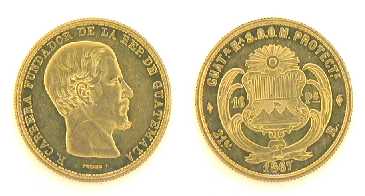
We know of the trial coinage of 1 peso, in 1852, from the collection of the former King Farouk, with the bust of Rafael Carrera on one side and the other the shield of the Republic adopted since 1847. However, the House of Representatives by decree of April 21, 1853, stated that the numerary of the Republic would have the same specifications as that of the Federation, but with its own design, which would have on one side the shield of the Republic and the other a bust of Christopher Columbus. In 1854 they coined a few coins of 8 reales with the characteristics dictated by the House of Representatives, but in 1857, after being declared "Lifelong President" Rafael Carrera was decided to change the bust of Christopher Columbus, by his.
During the years that the Guatemalan Mint remained almost paralyzed, coins of the Federation circulated in the country, with countermarks such as 1838, 1841, California tejos (an octagonal rough shape of 21.5 carats), U.S. Eagles, British pounds, francs and gold coins of Costa Rica. In the absence of circulating currency, circulation of coins from England (1 pound 1 shilling), the U.S. (1 dollar, 50 and 25 cents), France (1 French), Chile (10 pesos) and Costa Rica (8 escudos) was authorized.
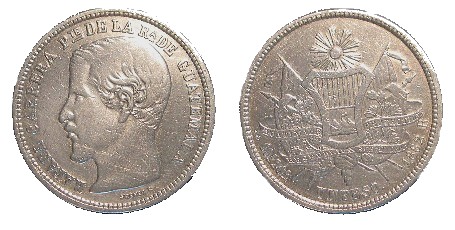
Mint began minting the formal currency of the Republic, in denominations of 1 / 4, 1 / 2, 1, 2 and 4 reales and 1 peso in silver 0.9030, and 4 reales, 1, 2 and 4 pesos in gold 0.8750. They also coined coins of 5, 8, 10, 16 and 20 pesos in gold 0.8750 and 0.900. All currencies, except for 1 / 4 real, bearing the portrait of the dictator Rafael Carrera. The "pesos Carrereños," as they were called, enjoyed great prestige, and were of official and unofficial circulation throughout Central America and Belize, they also circulated throughout Latin America and even in the Philippines. In 1861 and 1862, El Salvador counter-marked with an "R" (standing for rehabilitated) coins of 1, 2 and 4 reales and 1 peso of the Republic of Guatemala. Because a lot of numerary made by the Guatemalan Mint was exported at this time, in spite of the great quantity manufactured, (574.570 gold coins and 9,198,295 and silver coins) then again one starts to feel the lack of circulating currency in the country.
On April 11, 1865, the "Perpetual President" Rafael Carrera died. He is replaced by President Vicente Cerna, who ruled from 1865 to 1871. But the portrait of Carrera was still minted until 1871. From 1866 with the inscription "Founder of the Republic of Guatemala" instead of "President of the Republic of Guatemala", used in previous years.
Because the currencies of Guatemala did not follow the patterns adopted by other nations, that prevented them to be used for commercial transactions with the United States and Europe. So in 1869 it was decided to reform the monetary system. From that year the value of the coins begins to be expressed in terms of the metric system instead of the colonial nomenclature 10Ds20Gs (0.90277) for silver and 21 carats (0.8750) for gold coins. They also began to mint silver coins with a grade of 0.900 and gold with the grade of 0.8750, with diameters used for the U.S. dollar. An attempt was also made at first to introduce the metric system in the nomenclature of the coins, using sub-multiples of 1, 5, 10 , 25 and 50 cents instead of 1 / 4, 1 / 2, 1, 2 and 4 reales respectively, but due to lack of habit within the population, this reform was not successful and only coins of 1, 25 and 50 cents were minted. The 1871 penny was minted in copper.
Rafael Romaña was the first essayer of the Guatemalan Mint from 1859 to 1871, his initial "R" was coined in all currencies during this period except in the 1/4 of the real and 1 cent of 1871, in which was not included the assayer's initials.
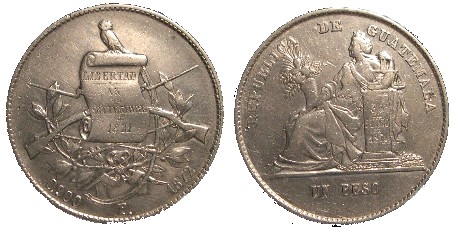
THE REFORMATION. On June 30, 1871, the revolution headed by Miguel García Granados and Justo Rufino Barrios triumphs against the unpopular government of Cerna. García Granados assumes the presidency and holds office until his resignation in 1873. During his presidency the national coat of arms was created, it is still minted today in all the Guatemalan coins with slight variations, the bust of Carrera not being minted anymore from 1872 and they go back to the pattern of pesos and sub-divisions of reales as opposed to the unpopular sub-multiples in cents.
Following the resignation of García Granados, Justo Rufino Barrios became president, until his death in 1885. During his administration he banned the circulation of macacos, giving their holders 3 days to exchange them in the Guatemalan Mint for coins or vouchers. In 1881, the second attempt to introduce the decimal system and the pattern of sub-multiples of cents was also unsuccessful. They coined to that effect coins of 5, 10 and 25 cents made of silver, and 1 cent of copper. Only 25 cent coins continued to be minted until 1893, others were minted only during the year 1881, proceeding the same year or shortly thereafter to coin their equivalents in sub-multiples of reales. Also in 1881, the coinage of Private coins and Farms tokens was officially approved, as the practice had been going on long before. Several medals were minted under President Barrios's mandate. In 1885, Justo Rufino Barrios proclaimed the Centro American Federation assuming command of the Unionist troops to invade neighboring countries. In that attempt Barrios was killed at the Battle of Chalchuapa, El Salvador, on April 2 of that same year.
Once Barrios is dead, Manuel Lizandro Barillas takes over, and makes peace with the Central American Republics. Through diplomacy, he tried to unify them and in 1889, the Covenant of the Union was held, and 2 trials were minted in copper, of 1 and 2 cents of the Central American Union that never came to circulate in reality.
In 1892, General Jose Maria Reyna Barrios assumes the presidency of Guatemala. From a numismatic point of view in the years 1892 and 1893 there were no major changes in the coins, the coinage being quite low in 1892 and with many variants in 1893, as in the example of "quarter" (cuartillo) of that year, there are more than 7 variants. In 1892 they returned to minting coins of 2 reales, which in previous years had been replaced by the 25 cents coins. On this year and next , both kinds of sub-multiples were minted with the same design and dimensions.
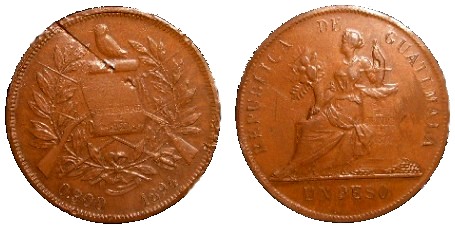
In 1894, local coinage begins in denominations of 1 / 4, 1 / 2, 1 and 2 reales of silver 0.835 and 4 reales and 1 peso of silver 0.900. The picture above is an essay in copper 1 peso from 1894. For foreign coinage they hired the British firm The Mint, Birmingham, Limited. With an "H" that distinguishes them from the local coins, this firm minted coins in all denominations during 1894 and 1895 except for 4 reales coin that was not coined in 1895. Also in 1894, they proceeded to reseal the foreign currency to the legal purity standards, and the circulations of coins that do not meet this standard is prohibited. The local emissions continued regularly until 1898, when President Reina Barrios was killed and instead a new dictator, Manuel Estrada Cabrera, assumes power and keeps it until 1920.
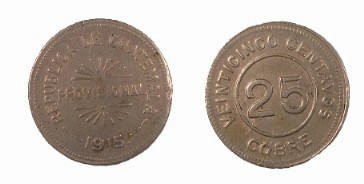
During the 22 years of the Estrada Cabrera administration, only small fractions of coins were minted. The grade of silver fell from 0.835 to 0.500 in 1900, when the firm, The Mint, Birmingham Limited was hired back to manufacture coins made of nickel in denominations of 1 / 4, 1 / 2 and 1 real. Minting was repeated in 1901. In 1910, 1911 and 1912, The Mint manufactures once again Guatemalan nickel coin money but this time only in the denomination of 1 real. It is not until 1915, that the Guatemalan Mint manufactures coins in Guatemala again, this time in copper and in denominations of 12 1 / 2 and 25 cents. In the picture below is a trial of 25 cents in alpaca. During the Estrada Cabrera administration, the Guatemalan Mint devoted itself almost exclusively to coin allegorical Medals to satisfy the ego of the dictator.
In 1920, Estrada Cabrera is deposed. Instead Deputy Carlos Herrera assumes the Presidency , but he is also deposed 20 months later. His only numismatic contributions were porcelain coins of 2 real made in Germany and from which few specimens are known, and an essay of 1921, of 1 peso made of nickel.
In December 1921, General Jose Maria Orellana assumes the presidency and to solve in the short term the absolute lack of currency, he sends for minting in 1922, coins of 50 cents and in 1923, coins of 1 and 5 pesos. The minting was done by the Guatemalan Mint, of bronze and aluminum. Assays are known of coins of 1 peso in 1923 made of aluminum and 5 pesos made of silver and bronze in 1922 and gold in 1923. To correct the financial problem permanently in 1924, he created a new monetary unit, "El Quetzal", so we move on to our last numismatist period.
For any suggestion or for further information, please let us know.
Monedas de Guatemala
Victor Hugo Sandoval
Home page